
Quantity Pricing
Set the markup and yield allowance for each quantity tier, and learn how markup differs from margin so your prices land where you intend.
On this page
This tab sets how much Quote adds on top of your cost for each order size. Each row is a quantity tier with its own markup and yield. You open it when you want to give volume discounts, protect margin on small orders, or allow for parts that scrap often.
Open it from the Pricing page, second tab, Quantity Pricing. Edits save automatically.
Quantity Tiers#
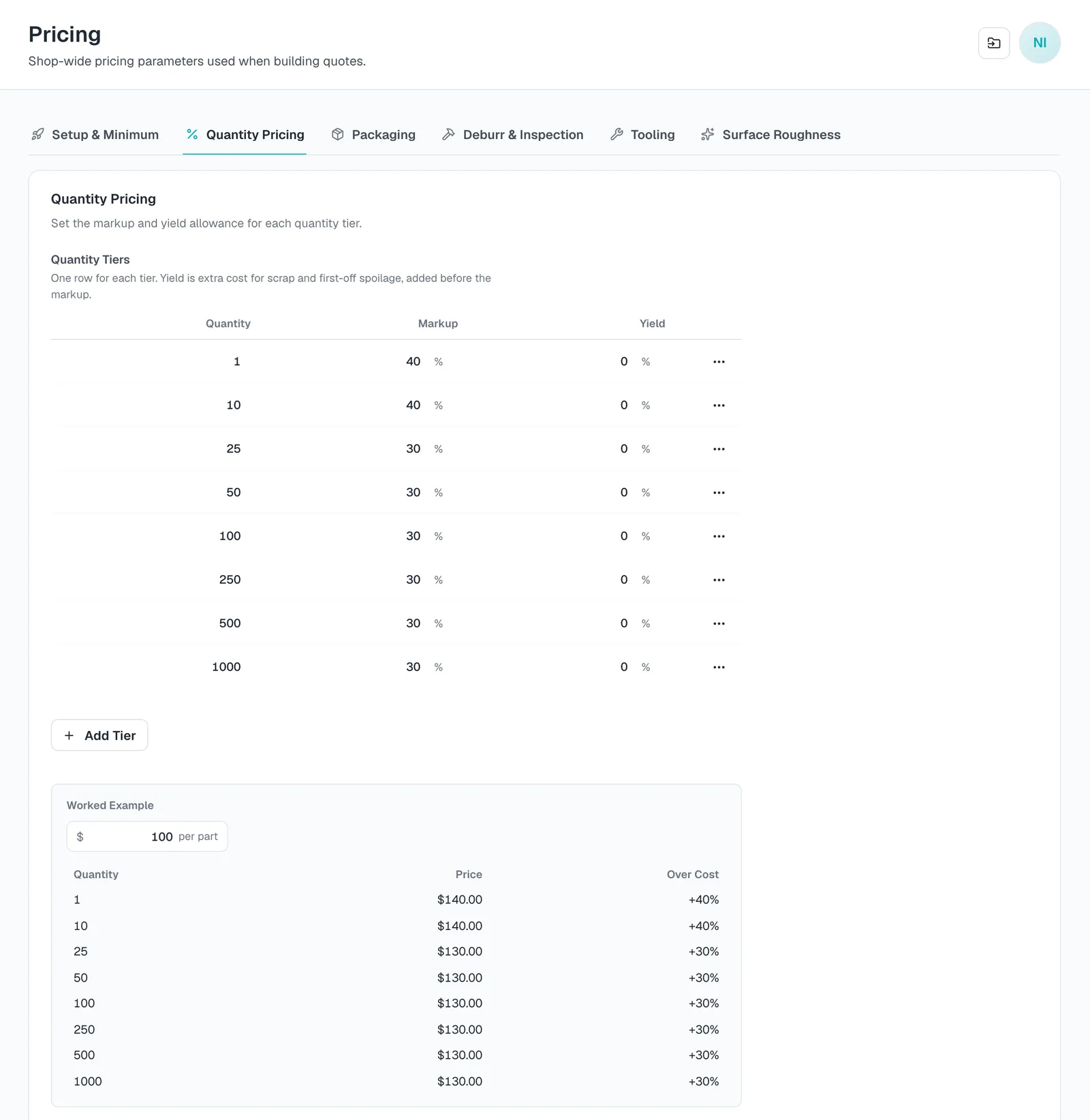
One row for each tier. Yield is extra cost for scrap and first-off spoilage, added before the markup.
| Column | Type | Range | Meaning |
|---|---|---|---|
| Quantity | Whole number | Above 0 | First quantity the tier applies to |
| Markup | Percent | 0 or more | Margin on top of cost |
| Yield | Percent | 0 or more | Extra cost for scrap and first-off spoilage |
Starting tiers are 1, 10, 25, 50, 100, 250, 500 and 1000. Markup starts at 40% for tiers 1 and 10, and 30% for every other tier. Yield starts at 0%.
Add Tier suggests the next quantity. A new row copies the markup and yield of the tier below it (30 and 0 if there is none). The last tier cannot be deleted. A delete shows an Undo notice.
Tier Rule#
An order uses the highest tier whose quantity is at or below the order quantity. A quantity of 7 uses the tier for 1. A quantity of 600 uses the tier for 500.
Watch out: always keep a tier at quantity 1, or small orders have no tier to land in.
Markup#
Unit: percent of cost. Starting value: 40 at quantity 1 and 10, 30 above. Where: Pricing, Quantity Pricing.
Quote multiplies the cost by (1 + markup %). It is a markup on cost, not a margin on price.
Change it when: lower the markup at higher volumes to win repeat orders. Raise it on one-off orders, where the work is the same but there is nothing to spread it over.
Yield#
Unit: percent. Starting value: 0. Where: Pricing, Quantity Pricing.
Extra cost for scrap and first-off spoilage, added to the subtotal before markup:
price = cost x (1 + yield %) x (1 + markup %)
Example: cost 100, yield 3%, markup 40% gives 100 x 1.03 x 1.40 = 144.20.
Change it when: a part scraps often, such as tight tolerances or hard material. A few percent is typical.
Watch out: yield is applied before markup, so the yield is marked up too. The material scrap multiplier is separate from yield, so do not count the same loss in both. See How Prices Are Built.
Markup Versus Margin#
Markup is a percentage of your cost. Margin is a percentage of your price. They are not the same number: a 40% markup is a 28.6% margin.
margin = markup / (1 + markup)
| Markup | Margin |
|---|---|
| 20% | 16.7% |
| 25% | 20.0% |
| 30% | 23.1% |
| 35% | 25.9% |
| 40% | 28.6% |
| 45% | 31.0% |
| 50% | 33.3% |
To work backwards from the margin you want: markup = margin / (1 - margin). A 25% margin needs a 33.3% markup.
Guidance#
- Keep a tier at quantity 1.
- Step the markup down as quantity goes up, as in the starting tiers (40% for 1 and 10 pieces, 30% above).
- Use yield for parts that scrap often, not for a general cushion. A general cushion belongs in markup.
- Check a quote at the boundary of two tiers, for example 9 and 10 pieces, to see that the price steps the way you expect.
Tip: After changing a tier, request a quote at the first quantity of that tier and at one piece below it. The two prices show you what the change did.
Related Pages#
Last updated