
Turning Tools
Every lathe tool type and field in Quote, how inserts, boring bars, drills and taps are selected, and the seeded starting inserts.
On this page
The Turning Tools screen is the list of inserts, boring bars, grooving and parting tools, and axial drills, reamers and taps your lathes use. Quote only picks from tools on this list. If a size is missing, Quote shows a missing tool warning or flags the quote for manual review. Open this screen when you change inserts, add a boring bar, or see a missing tool warning on a turned part.
Each tool type has its own tab with search, plus export, import and copy of that type as JSON. Import replaces only that type. Edits save per field.
Warning: There is no range check on tools. An impossible value is accepted and produces bad quotes, so double check what you type.
Tool Types#
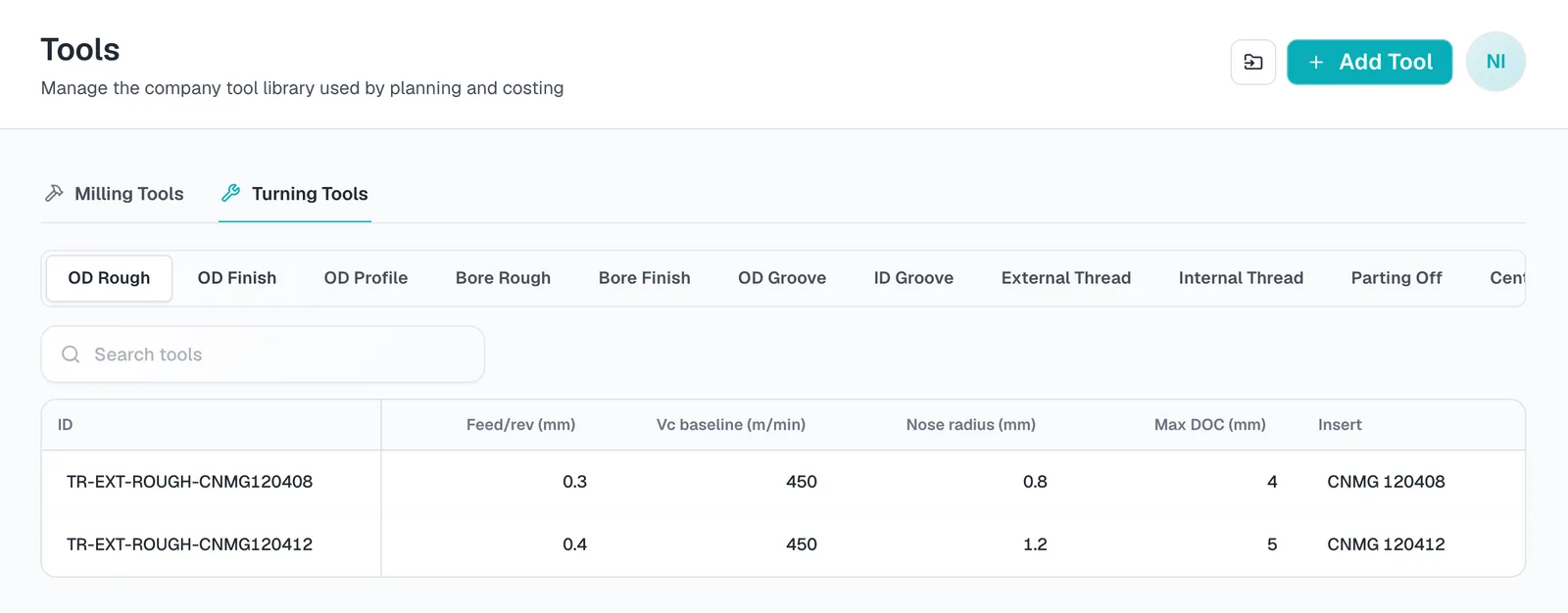
The tabs are External Rough, External Finish, External Profile, Bore Rough, Bore Finish, OD Groove, ID Groove, External Thread, Internal Thread, Parting, Center Drill, Axial Drill, Axial Reamer and Axial Tap. Columns depend on the type.
| Column | Shown for |
|---|---|
| Nose radius | External and bore types |
| Max DOC | Every type except drill, reamer, tap and thread |
| Width and Max OD | Groove and parting |
| Shank, Min bore, Max bore depth | Bore types |
| Diameter | Axial types and center drill |
| Pitch | Axial tap |
| Insert and Description | Always |
A new lathe tool starts with nose radius 0.8, Max DOC 2.0, Feed/rev 0.15 and Vc baseline 200.
Tool Fields#
ID#
Unit: text, must be unique. Where: Turning Tools, every tab.
A short name for the insert or tool in your catalogue. Keep a type prefix and size so quotes and tool lists are readable.
Type (Set by the Tab)#
Where: the type tabs above the table.
There is no Type column. A tool's type is set automatically by the tab it lives on: external rough, bore finish, drill, thread, parting and so on. The type decides which operations may use the tool. When you add a tool, it is created in the tab you have open, so switch to the right tab first.
Feed/Rev#
Unit: mm per revolution. Starting value: 0.3 and 0.4 for the starting roughing inserts, 0.06 and 0.1 for the starting finishing inserts. Where: Turning Tools, every tab where shown (label: Feed/rev).
How far the tool advances per spindle revolution.
The material's milling Feed multiplier scales this value. Threads and taps follow the thread pitch instead.
Change it when: roughing 0.25 to 0.4, finishing 0.05 to 0.12.
Watch out: never exceed about half the nose radius for a finishing insert.
Vc Baseline#
Unit: m/min. Starting value: 450 for roughing inserts, 550 to 600 for finishing inserts. Where: Turning Tools, every tab where shown (label: Vc baseline).
The baseline cutting speed (surface speed) for this insert before material adjustments.
The material's lathe Feed multiplier scales this baseline. Spindle speed is limited by the machine's maximum RPM.
Change it when: enter the speed for your reference material (aluminum). Hard materials are handled by the material multipliers, so do not also lower the baseline for them.
Nose Radius#
Unit: mm. Where: Turning Tools, external and bore types.
The corner radius on the insert tip. External finishing picks the smallest nose radius in your catalogue.
Max DOC#
Unit: mm. Where: Turning Tools, every type except drill, reamer, tap and thread.
The deepest cut this insert can take in one pass (depth of cut).
The material's lathe DPP multiplier scales this value, and Quote keeps cuts within safe limits for long, slender parts. If the field is empty, Quote uses a sensible default depth.
Width#
Unit: mm. Where: Turning Tools, groove and parting types.
The width of a groove or parting insert.
Quote picks the insert that best fits the groove. For a parting tool, it picks a width whose Max OD covers the bar.
Max OD#
Unit: mm. Where: Turning Tools, groove and parting types.
The largest outside diameter this groove or parting tool can cut. Quote uses it when selecting a parting tool, which must cover the bar.
Shank#
Unit: mm. Where: Turning Tools, bore types.
The diameter of the boring bar shank. Among bars that fit the bore, Quote chooses the largest shank because it is the stiffest. If Max bore depth is empty, Quote applies a default depth limit based on the shank.
Min Bore#
Unit: mm. Where: Turning Tools, bore types (label: Min bore).
The smallest hole diameter this boring bar can reach. A bar qualifies when its Min bore is at most the bore diameter + 0.1 mm (+ 0.5 mm for ID grooves and internal threads).
Max Bore Depth#
Unit: mm. Default: empty (a default limit applies). Where: Turning Tools, bore types (label: Max bore depth).
The deepest bore this bar can reach. Bores past this depth are cut at a 30 percent feed derate (feed x 0.7) and raise a warning.
Diameter (Axial Tools)#
Unit: mm. Where: Turning Tools, axial drill, axial reamer, axial tap and center drill.
The cutting diameter for drills, reamers or taps used on the lathe.
- Axial drill: the largest diameter not above the target + 0.05 mm, otherwise the smallest.
- Reamer and tap: within 0.5 mm of the target, otherwise Quote raises a missing tool warning.
- Internal threads up to 12 mm are tapped when an axial tap exists.
- Deep holes are drilled with pecking, which adds time.
Change it when: stock every drill, reamer and tap size you use. Missing sizes cause missing tool warnings and manual-review quotes.
Pitch#
Unit: mm. Where: Turning Tools, Axial Tap only.
The distance between thread crests (thread pitch). Tap feed follows the pitch.
Insert#
Where: Turning Tools, every tab.
The commercial insert code, for example CNMG 120408. It is informational and has no effect on cost.
Description#
Where: Turning Tools, every tab.
Your own notes about this tool for the shop floor. It is informational and has no effect on cost.
How Quote Selects Turning Tools#
| Job | Rule |
|---|---|
| External roughing | The insert with the largest Max DOC when no depth target is stated. |
| External finishing | The smallest nose radius in the catalogue. |
| Boring | Among bars whose Min bore fits, the largest shank. |
| Grooving | The widest insert up to groove width + 0.05 mm, else the narrowest. |
| Parting | The smallest width whose Max OD covers the bar. |
| Axial drilling | The largest drill up to target + 0.05 mm, else the smallest. |
| Reaming and tapping | Within 0.5 mm of the target diameter. |
| Threads | The first matching internal or external thread insert. |
If a job needs more distinct tools than the lathe has turret stations, Quote adds manual tool-swap time for each extra tool.
Seeded Starting Inserts#
New shops are seeded with 28 tools:
| Type | Starting tools |
|---|---|
| External rough | CNMG120408 (nose 0.8, Max DOC 4, Feed/rev 0.3, Vc 450) and CNMG120412 (nose 1.2, Max DOC 5, Feed/rev 0.4, Vc 450) |
| External finish | DNMG110402 (nose 0.2, Max DOC 0.5, Feed/rev 0.06, Vc 600) and DNMG110404 (nose 0.4, Max DOC 1, Feed/rev 0.1, Vc 550) |
| External profile | VNMG160404 |
| Bore rough and bore finish | Boring bars at shank 10, 16 and 25 |
| OD groove | 2 and 3 mm |
| ID groove | 3 mm |
| Parting | 2 and 3 mm |
| Threads | External and internal ISO thread inserts |
| Center drill | One |
| Axial drills | 6, 10, 16, 25 mm |
| Axial reamers | 8, 10, 12 mm |
| Axial taps | M6, M8, M10 |
Common Mistakes#
- Entering speeds and feeds for the hardest material and then also applying material multipliers, which slows the job twice.
- Missing small drills or taps, which cause missing tool warnings and manual-review quotes.
- Using a lathe Feed mult. on a material to fix feed per revolution. That field changes cutting speed. Feed per revolution follows the milling Feed mult.
Related Pages#
Last updated