
Deburr and Inspection
Set the labour rates, edge times, tumbling and inspection times that decide what deburring and checking add to each part.
On this page
This tab sets the rates and times behind deburring (removing sharp edges and burrs) and inspection (checking the finished part). Quote counts the edges and features on each part and prices the labour from the numbers here. You open it when you want the labour to match what your floor really spends.
Open it from the Pricing page, fourth tab, Deburr and Inspection. The starting values below are what Quote uses until you change them.
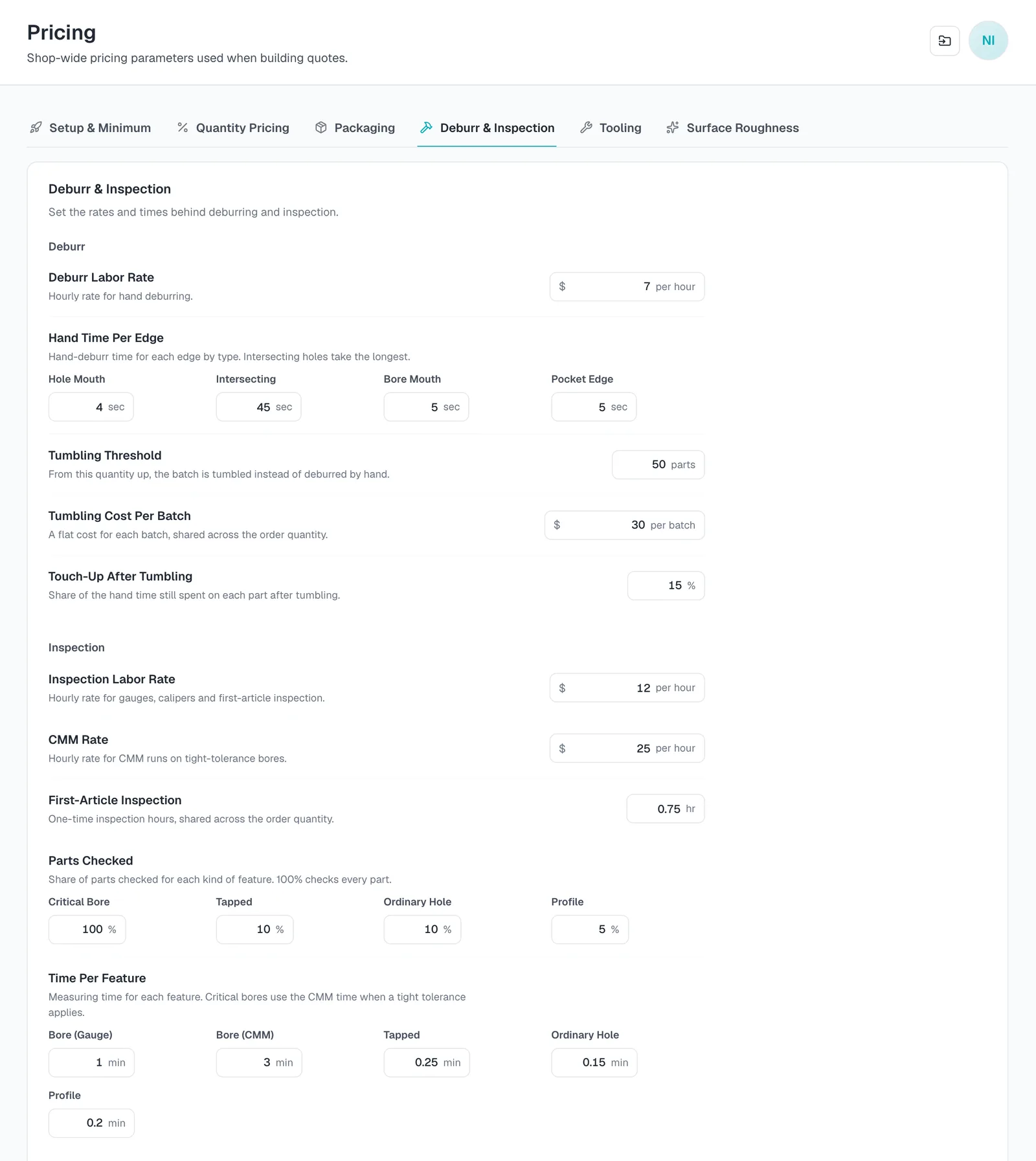
Deburring#
Hand minutes come from edge counts multiplied by seconds per edge type. Hand cost = minutes / 60 x labour rate.
Labour Rate (Deburring)#
Unit: per hour. Starting value: 7.0. Where: Pricing, Deburr and Inspection, Deburring.
The hourly cost of whoever deburrs.
Change it when: set it to your real deburr labour cost.
Seconds Per Edge#
Unit: seconds. Where: Pricing, Deburr and Inspection, Deburring.
The time to deburr one edge of each type.
| Edge type | Starting value | What it is |
|---|---|---|
| Hole Mouth | 4 s | The opening of a hole |
| Intersecting | 45 s | A hole mouth where holes cross |
| Bore Mouth | 5 s | The opening of a bore |
| Pocket Edge | 5 s | An edge of a pocket-type feature |
How Quote counts edges:
- A through hole has 2 mouths. A blind hole has 1.
- A countersink or counterbore removes 1 mouth.
- Holes and bores whose axes cross (not parallel, and within the radii plus 0.5 mm) use the Intersecting time.
- Bores use the Bore Mouth time.
- Pocket-type features count their internal corners plus a rim base: rectangular pocket, closed slot and freeform pocket count 4, step, open slot and slit count 2, circular pocket counts 1.
- Chamfers and fillets are treated as already broken, so they add no deburr time.
Example: a part with four through holes has 8 hole mouths x 4 s = 32 s of hand time. At a labour rate of 7 per hour that is 32 / 3600 x 7 = 0.06 per part.
Tumbling Threshold#
Unit: quantity. Starting value: 50. Where: Pricing, Deburr and Inspection, Deburring.
The order quantity at which Quote prices tumbling (batch deburring in a drum) instead of hand deburring.
Change it when: set it to the quantity at which you really start tumbling. If you never tumble, set the threshold above any realistic quantity, or set the batch cost to 0.
Tumbling Cost Per Batch#
Unit: per batch. Starting value: 30. Where: Pricing, Deburr and Inspection, Deburring.
What one tumbling run costs you.
Touch-Up After Tumbling#
Unit: fraction of hand time (0.15 means 15%). Starting value: 0.15. Where: Pricing, Deburr and Inspection, Deburring.
The share of the hand time still done after tumbling.
If the quantity is at or above the threshold and the batch cost is above 0:
deburr per part = batch cost / quantity + hand cost x touch-up fraction
Otherwise deburr per part = hand cost.
Example: quantity 100, batch cost 30, hand cost 1.00 per part. Deburr per part = 30 / 100 + 1.00 x 0.15 = 0.45, against 1.00 by hand.
Inspection#
Labour Rate (Inspection)#
Unit: per hour. Starting value: 12. Where: Pricing, Deburr and Inspection, Inspection.
Used for gauge checks and for first-article inspection.
CMM Rate#
Unit: per hour. Starting value: 25. Where: Pricing, Deburr and Inspection, Inspection.
The hourly cost of your coordinate measuring machine (CMM). Used only for critical bores when a CMM is required.
First-Article Inspection#
Unit: hours. Starting value: 0.75. Where: Pricing, Deburr and Inspection, Inspection.
The time to fully inspect the first part. It is spread across the order, so it matters most on small orders.
first-article cost per part = hours x labour rate / quantity
Example: 0.75 h x 12 = 9.00 for the order. At quantity 10 that is 0.90 per part, and at quantity 100 it is 0.09.
Parts Checked#
Unit: share of parts checked, 0 to 1. Where: Pricing, Deburr and Inspection, Inspection.
| Feature priority | Starting value |
|---|---|
| Critical bore | 1.0 |
| Tapped | 0.1 |
| Ordinary hole | 0.1 |
| Profile | 0.05 |
Change it when: raise these if customers require 100% inspection.
Time Per Feature#
Unit: minutes. Where: Pricing, Deburr and Inspection, Inspection.
| Feature | Starting value |
|---|---|
| Bore (Gauge) | 1.0 |
| Bore (CMM) | 3.0 |
| Tapped | 0.25 |
| Ordinary hole | 0.15 |
| Profile | 0.2 |
Recurring inspection cost = sum over features of count x minutes / 60 x share checked x rate.
CMM Rules#
Quote classes each feature by priority: critical bore first (a bore, reamed, tight tolerance or honed feature), then tapped, then ordinary hole. Pocket-type features count as profile.
A CMM is required only when the part has a grinding-class tolerance (such as H6 or h6) or a hone callout. When a CMM is required, the CMM Rate and the Bore (CMM) minutes apply to critical bores only. Everything else uses the Labour Rate (Inspection) and the gauge minutes.
Example: a part with 2 critical bores and no CMM requirement: 2 x 1.0 / 60 x 1.0 x 12 = 0.40 per part, plus the first-article share.
per part inspection = first-article hours x labour rate / quantity + recurring inspection
Related Pages#
Last updated