
Start by timing your own quotes
We are not going to tell you how long a manual CNC quote takes, because the honest answer is that it depends on your shop, and any number we printed here would be worse than useless.
What is worth doing is measuring your own. Take the last twenty quotes you sent and note, for each one, the time the enquiry arrived and the time the quote went out. Do not include weekends or enquiry replies unless you were the one replying. The distribution is usually the interesting part. Most shops find something closer to a bimodal shape than an average: quick quotes for parts they have quoted before, and very long ones for parts that need thought.
Then do one more thing, which is the part most shops skip. Ask why the long ones were long. The answer is almost never "the estimating was hard". It is usually that the file needed opening twice, the material price needed chasing, or the person who knew which machine was right was in the middle of something else.
Where a manual quote actually goes
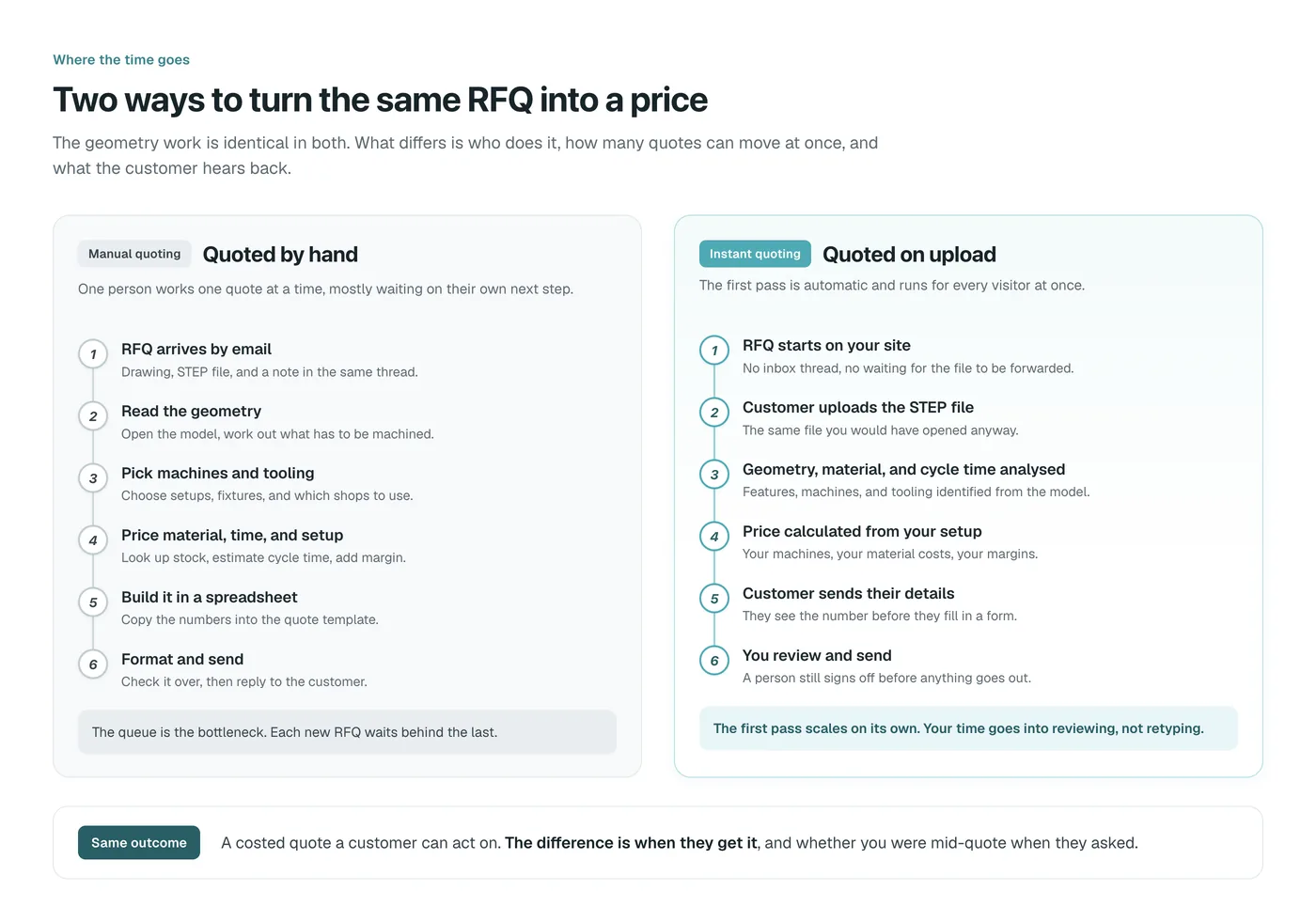
The steps look like this, and they are the same for every shop:
- The enquiry arrives as an email, usually with a drawing or a STEP file attached, and sometimes with three questions in the body.
- Someone opens the file and works out what has to be made. Features, datums, tolerances, how many operations, and whether it is even a part you want.
- Machines and tooling are chosen. Which machine, which fixture, whether it is a repeat part you have tooling for.
- Material, time, and setup are priced. Stock price, cycle time, setup, consumables, and then a margin.
- It is built in a spreadsheet and formatted into something a customer can read.
- Someone checks it and sends it.
Look at that list again. Steps 2, 4, and 5 are mechanical. They are the same computation every time, with different inputs. That is the part that is ripe for a machine, and it happens to be most of the wall-clock time.
The bottleneck is the queue, not the work
Here is the thing that gets missed when people talk about quoting speed: an estimator can only work on one quote at a time. Everything else waits.
So when a shop says quoting is slow, what it usually means is that there is a backlog. The estimator is not slow. The estimator is four quotes deep on a Friday afternoon and the fifth one is not going out until Monday.
This reframes the whole problem, because the fix is not "estimate faster". It is "estimate more than once at the same time". No amount of estimator training or a better spreadsheet template changes that number. Only automation changes it, and only for the mechanical steps.
There is a second-order effect too. Because the answer arrives late, more enquiries go elsewhere. That is the cost, and it is the reason quoting speed shows up in win rate rather than in a timesheet.
What an instant quoting widget changes
An instant quoting widget moves steps 2, 4, and 5 out of the queue. The customer, or the enquiry, runs through them immediately, at whatever hour they happen to be at their desk.
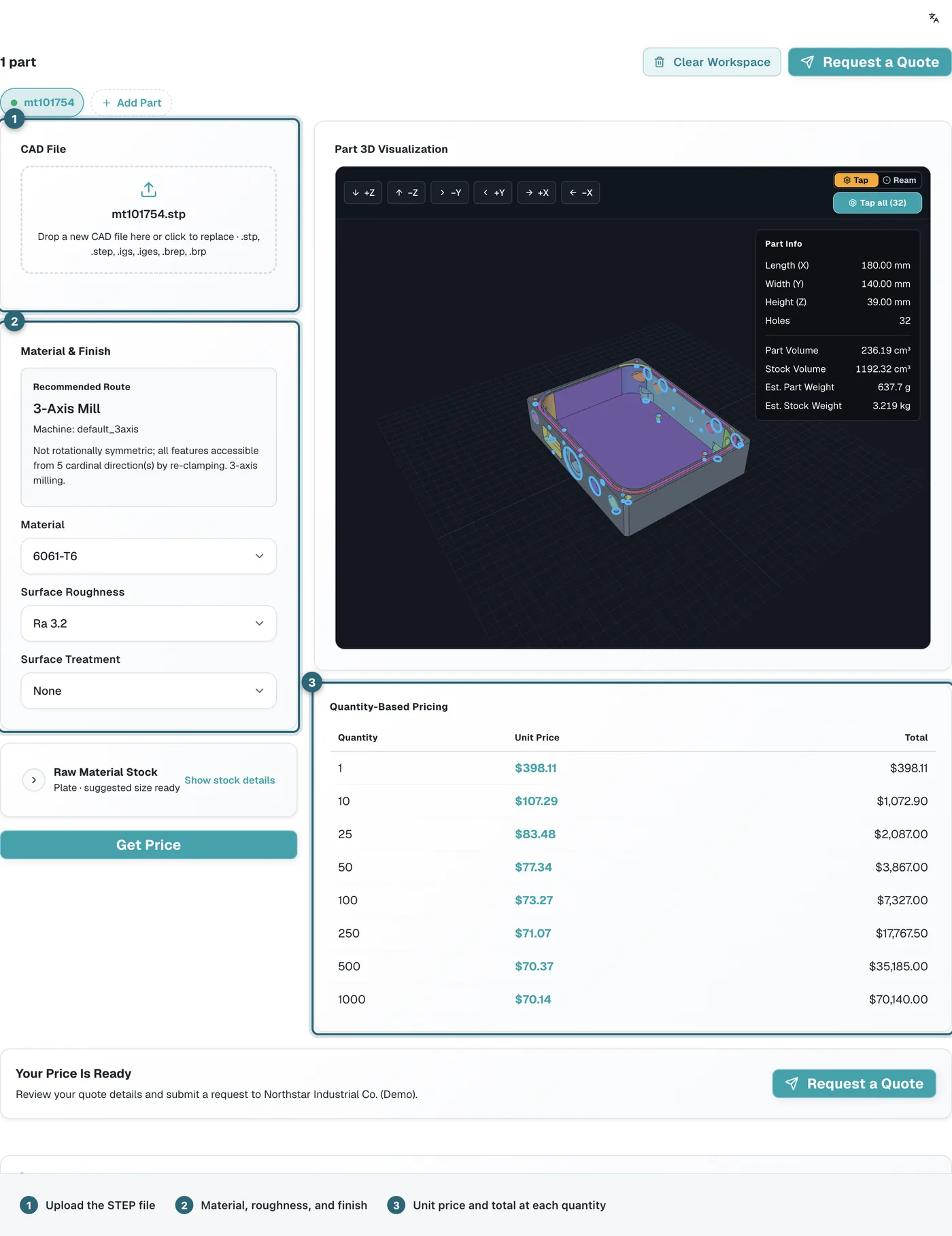
The widget takes a STEP, IGES, or BREP file, reads the geometry, picks a process route, and applies your shop's materials, machines, tooling, and margins. It shows a price, and a price at each quantity, because the volume pricing a customer is actually thinking about is rarely the price for one part.
What it does not do is send a quote. The customer submits a request, and it lands with your team with the analysis already attached. Your estimator opens a finished first pass instead of a blank spreadsheet.
The practical difference is that this work now happens for every enquiry simultaneously rather than one at a time. It does not matter that your estimator is busy, because the estimator is not the one doing it.
What is left for your team
Being precise about this is worth the effort, because the sales pitch for automatic quoting usually overstates it.
Your estimator still reviews. They still send it. They still handle the DFM flags that a machine flagged but cannot resolve. And they still apply everything the analysis does not know about: lead time, the relationship, the customer's history of paying late, and whether you actually want the work.
None of that is a weakness of the tool. None of it is what a machine should be doing. What changes is that they are doing it on a number that already exists, instead of producing that number first.
When manual quoting is still right
There are jobs where instant quoting is the wrong answer, and shops that adopt it broadly end up worse off.
- Prototype and one-off work. The cost is not geometry, it is the conversation about what is possible. A number in a browser does not answer that.
- Work where your knowledge is undocumented. If the estimator knows this part is always a problem and that one always needs a second op, and none of that is in a system, automation will price the geometry correctly and still miss the real cost.
- Customers who need a relationship. A quote sent by a person with a phone number is a different offer from a number on a web page. If you win on trust, do not throw away the person.
- Anything where you would rather quote high and negotiate. Anchoring low in public is not always the move.
The sensible split is usually to automate the enquiries you would have quoted anyway, and keep the human conversation for the ones that matter.
Getting started
The Asytra Quote widget is embedded with a script tag and a key, and it runs on your own domain so customers see your branding rather than a third party's. The dashboard and the widget share the same shop configuration, which means the price a visitor sees and the price your estimator sees come from the same settings. That part matters: if the widget used its own rates, the whole thing would be worthless.
Before you switch it on, get your shop settings right. Feed rates, material costs, machine rates, and margins. Price several parts you have already quoted by hand and compare. An inaccuracy in the configuration shows up identically in both paths, so this check matters more than anything else you do during setup.
How to add an instant CNC quoting system to your website covers the embedding in detail. For the costing side, how to estimate CNC machining cost from a 3D model and milling versus turning cost calculation explain what the analysis is doing with your file. And if you want the same analysis from inside your own tools rather than a customer's browser, connecting an AI agent to CNC quoting covers the MCP route.
Frequently asked questions
It depends far more on your shop and your estimator's workload than on the part. The work is the same every time: open the file, understand the geometry, choose machines and tooling, price material and time, build the quote, format it, and send it. If you want a number, time your own last twenty quotes rather than trusting an average from somewhere else.
No. It replaces the first pass, which is the mechanical part: reading the file, identifying features, and applying your rates. A person still reviews the result and sends anything that goes to a customer. Shops that treat it as a first-pass filter get more out of it than shops expecting it to be autonomous.
It changes which enquiries you can respond to at all. If a customer sends a file at the end of the working day and needs a price before they place the order, a quote that arrives tomorrow is sometimes worth more than a quote that never arrives. Whether that converts depends on your market and your lead times, and no tool can promise it for you.
For genuinely bespoke work, prototype quantities, and anything where a customer needs a conversation rather than a number. It is also still the right choice when your process knowledge is in an estimator's head and not in a system. Automation prices the geometry well; it does not know your customer.
Asytra Quote provides a widget you embed with a script tag and a key. Visitors upload a STEP, IGES, or BREP file on your domain and get indicative pricing under your branding, then submit a request to your team. The dashboard and the widget use the same shop settings, so the numbers match.