
Stock shape drives the starting point
Milling cost calculation usually starts from a plate or block: bounding box dimensions plus clamping allowance on each axis. You pay for the rectangular volume even if the finished part is mostly air.
Turning cost calculation starts from bar stock: maximum outside diameter and part length, plus cutoff and facing allowance. For true rotational parts, bar stock is often more efficient because less material is wasted.
Get the stock model wrong and every downstream number is wrong. That is why automated quoting reads the 3D geometry before picking a process.
Cycle time: perimeter vs revolution
On a mill, cycle time comes from pockets, holes, profiles, and 3D surfacing. Each feature adds discrete cutting passes, tool changes, and repositioning. Complex prismatic parts can have long cycle times even when the part looks small.
On a lathe, cycle time is dominated by OD turning, boring, grooving, and threading along the spindle axis. For simple cylinders, turning is often faster per cubic centimetre removed because the tool stays in cut continuously.
Combined mill-turn parts need both models: lathe operations for the rotational body, then milling for cross-holes, flats, or keyways. Cost calculation must sum both without double-counting setup.
Setup and tooling differences
Milling setup includes vice or fixture placement, work offset probing, and sometimes multiple setups for different faces. Each reposition adds time that must be amortized across the batch.
Turning setup is usually faster for pure rotational work: chuck the bar, touch off, run. But live-tooling lathes add milling operations that bring mill-like setup costs back into the quote.
Tooling wear also differs. Aluminium milling is gentle on inserts; stainless turning at high feeds can burn through inserts quickly. Your cost calculation should reflect material-specific tool life, not a flat percentage on every job.
When to route to mill, lathe, or both
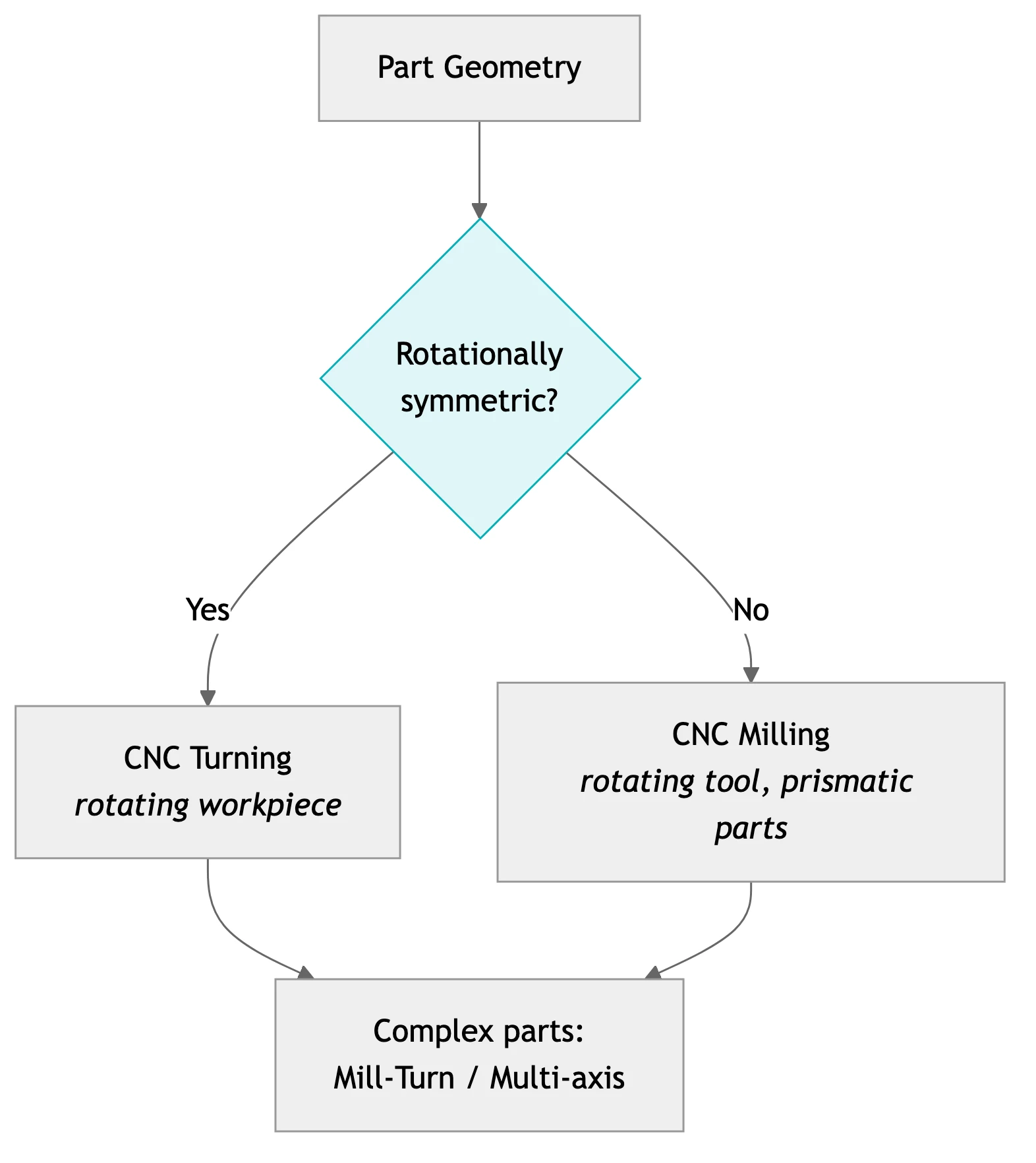
A good estimator asks: is this part primarily rotational or prismatic? Can it be made in one setup? Does it need 4-axis indexing?
- Turning: Shafts, bushings, knobs, and parts with rotational symmetry.
- Milling: Brackets, enclosures, plates, and parts with pockets on multiple faces.
- Combined / mill-turn: Parts with both cylindrical and milled features that are cheaper on one machine than two separate setups.
- 4-axis milling: Parts that need indexed access but are not lathe candidates.
Routing changes the entire cost calculation. The same hourly rate on the wrong process can overprice a simple shaft or underprice a part that needs three mill setups.
Quantity effects both processes the same way
Setup cost per part drops as quantity rises. A 45-minute mill setup on 5 parts adds 9 minutes each; on 100 parts it is negligible per unit. The same logic applies to lathe bar loading and first-article prove-out.
When you calculate CNC cost for a quote ladder (1, 5, 25, 100 pieces), make setup amortization explicit. Customers expect unit price to fall with quantity; your calculator should show that automatically.
Automating routing and cost calculation
Manual estimators develop intuition for mill vs lathe, but two people still route the same ambiguous part differently. Automated quoting analyses feature geometry, aspect ratio, and accessible faces to recommend milling, turning, combined, or 4-axis routing before calculating cost.
Asytra Quote does this from a STEP file: upload the model, review the recommended route, and see material, cycle time, and price at your configured rates. Try the free CNC cost calculator with demo shop rules, or read the full CNC cost calculation guide.
Related articles
- CNC Cost Calculation from a 3D Model
- How to View a STEP File Online for Free
- How to Add an Instant CNC Quoting System to Your Website
Frequently asked questions
Not always. Turning is often faster for rotational parts because material removal is continuous, but milling can be cheaper for prismatic parts that would need excessive lathe setup or live tooling. The right answer depends on geometry, quantity, and your shop rates.
Routing picks whether a part runs on a lathe, a mill, both, or a 4-axis setup. Each route has different cycle time, setup, and tooling costs. Automated quoting tools analyse geometry to recommend the lowest-cost feasible process.
Milling quotes typically start from a rectangular plate or block sized to the part bounding box plus clamping allowance. Turning quotes use bar stock diameter and length based on the maximum OD and part length.