
What ISO 9001 actually requires
Clause 8.5.1 of ISO 9001:2015 requires organizations to implement production under controlled conditions, which includes "the availability and use of suitable monitoring and measuring resources" and "the availability and use of documented information that defines the characteristics of products, activities to be performed, and results to be achieved."
In practice, this means: if an operator needs instructions to do their job correctly, those instructions must exist, be current, and be available at the point of use. The standard does not specify the format. Paper, PDF, or digital system all satisfy the requirement. What matters is that the instructions are controlled, current, and accessible.
Document control requirements
ISO 9001 clause 7.5 requires that documented information is controlled: approved before use, reviewed and updated as needed, available where needed, and protected from unintended alterations. For work instructions, this means:
- Each instruction has a revision number and approval date
- Obsolete versions are removed from circulation
- Changes go through a review and approval process
- The current version is available at the workstation
Paper-based document control is possible but labour-intensive. Every revision requires printing, distribution, collection of old copies, and documentation of the change. Digital systems handle this automatically: update the instruction, and every workstation shows the new version. The old version is archived, not deleted.
Records and traceability
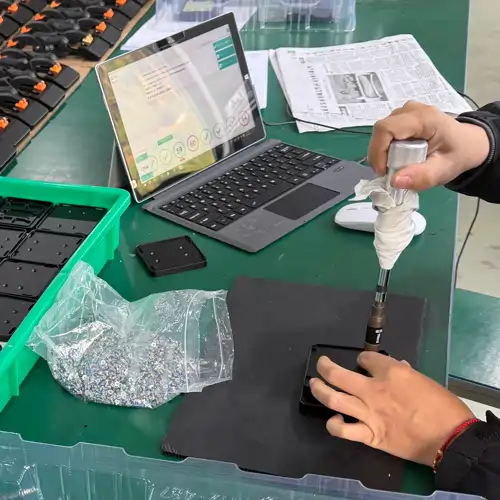
Clause 8.5.2 addresses identification and traceability. If traceability is a requirement (and in most B2B manufacturing it is), you need to maintain records that link each product to its production data. Digital work instructions that log every step completion, measurement, and quality check per serial number generate these records automatically.
What auditors look for
During an ISO 9001 audit, the auditor will check that work instructions exist for processes that need them, that the instructions match the current revision of the product design, that operators are actually using them, and that evidence of their use is recorded. An auditor walking the floor will ask an operator to show them the instruction they are following and compare it to the controlled version.
With a digital system, this is straightforward: the operator shows the instruction on their screen, and the system shows the version number, approval date, and the operator's progress through the steps. The audit trail is built in.
Common audit findings on work instructions
Nonconformities in this area follow a pattern. Knowing them in advance makes the audit routine:
- Instructions exist but are not at the workstation. The controlled copy lives in the office binder while the floor works from a photocopy of unknown revision. Clause 7.5.3 requires availability at the point of use, and auditors check this on the floor, not in the office.
- Revision drift. The instruction says revision 4 but the drawing at the station is revision 6. Any mismatch between instruction revision and design revision is a finding.
- No evidence of approval. An instruction was updated by engineering but the approval record (who reviewed it, when) is missing. Digital systems log this automatically; paper systems have to remember it.
- Obsolete versions still circulating. Laminated sheets at stations that nobody collected after the last revision. This finding is so common with paper that auditors check for it first.
- Instructions that do not match what operators actually do. The instruction says torque to 2.5 Nm, the operator does 2.0. Either the instruction is wrong or the process is out of control, and the auditor will write up whichever one it is.
What to do 30 days before an audit
- Walk the floor with the controlled instruction list and confirm the workstation copies (paper or on-screen) match the master list, revision by revision.
- Pick three instructions at random and verify approval signatures or system approval records exist for the current revision.
- Ask one operator to walk you through their instruction for a current build, exactly as an auditor would. Whatever they cannot show you is your finding.
- Check that records of execution (sign-offs, measurements) exist for recent serials and are retrievable. An auditor may ask for a specific serial number's record.
Asytra Trace provides version-controlled digital work instructions with full execution tracking per serial number, meeting ISO 9001 requirements for document control, traceability, and quality records. Learn more about Trace.
Related articles
- How to Create Digital Work Instructions for Manufacturing
- What Is Assembly Traceability and Why Your Customers Require It
Frequently asked questions
ISO 9001 requires documented information where its absence could lead to nonconformity. For most manufacturing operations, this means work instructions are required for assembly, inspection, and testing processes. The standard does not prescribe a specific format.
ISO 9001 clause 7.5 requires that work instructions are approved before use, reviewed and updated as needed, available at the point of use, and protected from unintended alterations. Each instruction must have a revision identifier and changes must go through a controlled process.
Yes. Digital work instructions satisfy ISO 9001 requirements for document control, provided they are version-controlled, approved before use, and available at the workstation. Digital systems often exceed the requirements by automatically tracking revisions, preventing use of obsolete versions, and recording execution data per serial number.